Short answer: yes
It’s the holiday season, which makes me maudlin and sentimental, which is one of my favorite ways to be. I am watching romantic comedies, I am fawning over pretty lights, I am making stews. When the weather gets cold, I believe in love.
Cat People is a reader-supported publication. To receive new posts and support my work, consider becoming a free or paid subscriber.
So I wanted to explore a question that I am asked not infrequently - can cats love? When I am asked this, it is often by people who don’t really like cats, and it is often accompanied by a smug smirk, as though it’s some sort of gotcha. “Silly you,” I can hear at the heart of the question, “you spend so much time thinking about the emotional state of animals that just want to eat and sleep and poop. They can’t love you back. They only have little stupid cat brains.”
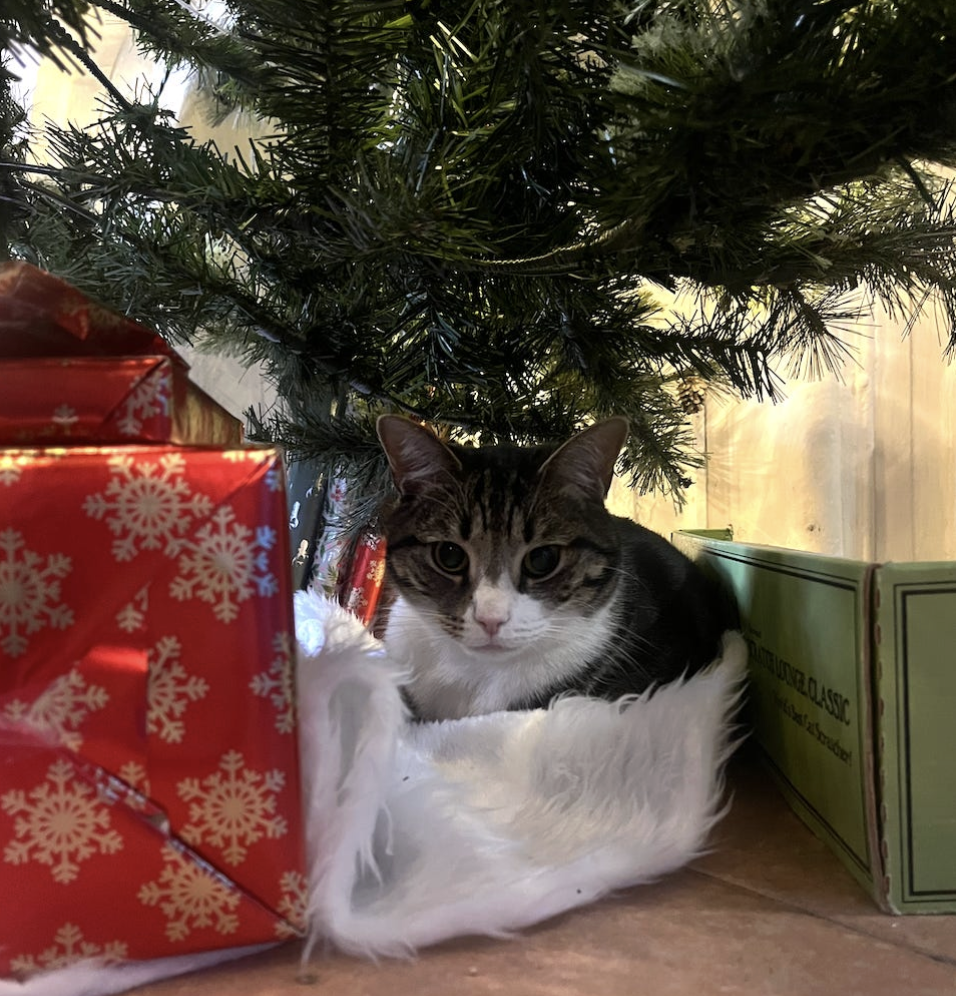
Look how shallow her brain pan is. How could she love?
Unfortunately, “love” is a little complicated to capture in a feline study. But there has been research on feline-human attachment.
In a 2019 study, researchers conducted the Secure Base Test (SBT) with cats. The SBT is a variation of the strange situation test, which you may have learned about in Psych 101 - it’s the one where children are first observed playing with their parents, and then exposed to strangers, and their behavior is evaluated to determine their attachment style.
The SBT is a simplified version that has previously been done with primates and dogs. In the SBT, animals are observed with caregivers for 2 minutes, left alone for 2 minutes, and then are reunited, and their attachment style is evaluated based on their behavior. Animals are considered to have a secure attachment style if they display limited stress behaviors and a “contact-exploration” balance with their caregiver. (In other words, if they come check in with the caregiver periodically, while also exploring the space.) Individuals considered to have an insecure attachment style if they remain stressed upon their caregivers return and either stay too close (ambivalent attachment), avoid contact (avoidant attachment), or vacillate between clinging and avoiding (disorganized attachment).
In that 2019 study, the SBT was first conducted with seventy-nine kittens between three and eight months of age. Seventy were able to be classified - of those kittens, 64.3% were categorized as securely attached, and 35.7% were categorized as insecurely attached. Of the insecure kittens, 84% were ambivalent, 12% were avoidant, and 4% were disorganized. The study was repeated with adult cats (over 1 year of age), and breakdown of attachment style was similar (65.8% secure, 34.2% insecure). This, by the way, mirrors the numbers found for human infants3 (65% secure, 35% insecure) and dogs (58% secure, 42% insecure).
I’ve written in the past about the flexibility of feline sociality - long story short, cats can live individually or in groups based on environment and available resources. The researchers of this study conclude that feline social flexibility also allows for cross-species attachment, and that the offspring-caretaker relationship that cats and humans form together is beneficial for cats as a species.
Any Cat Parent could tell you that they think of their cats as their babies, but it’s interesting to see it from the cat’s end of things. It’s not just that humans are projecting their own attachment needs onto their pets - our pets reciprocate it to some extent, and they need us too. (Of course they do, they rely on us for everything.)
There is the classic, speciesist take that if non-human love doesn’t exactly mirror human love, it doesn’t really count. Can you even call it love, if it’s not human? It might be familiarity, or dependence maybe. More cynically, human-cat relationships may just be an exchange of affectionate behaviors for goods and services (food and back rubs). If love is transactional, or rooted in dependency, is it really love? I do like pointing out that human love also serves a function - if you ask an EFT therapist, they’ll tell you that we are (and should be) dependent on our partners in much the same way we are dependent on our parents when we’re young. We rely on our loved ones to survive - we do it as children, and we do it as adults.
Does the fact that every kind of love is related to need make it less meaningful? Is attachment the same as love? What even is love, blah blah blah, listen - I am of the opinion that we should accept love wherever we can find it, in whatever form it takes. So what if they have evolved to capitalize on your inherent need to care for things? They love you back, in their way, as best as they’re able. That’s beautiful.
Can you apply this to your own cat?
In the time I’ve been working with behavior, I have been asked by multiple people if I think their cat hates them. My answer is no, because hate (to me) is an absolute, which makes it something that can’t be edited. The beautiful thing about cats is they are resilient and they live in the moment. A relationship with a cat may be troubled, but it is always possible to improve it.
A relationship between a person and a cat is something that’s built collaboratively. We don’t really think of it that way - many people think that you acquire a pet, the pet feels positively toward you by virtue of being an animal, and that’s all there is to it. But cats do have feelings and preferences (boy do they ever have preferences), and as with any healthy relationship, it’s our responsibility to try to understand them on their terms instead of operating solely from our own interests.
Here are a couple feline couples’ therapy tips, for those who want to improve their relationship with their cat:
Show interest in their interests: Play with them! Do fun stuff they like. When you play, pay attention to what they are especially interested in.
Value their bodily autonomy: Do you like to go find your cat, grab them, and squeeze them? Do they enjoy that? If they don’t, then cut it out. Think about how you can interact with them physically in ways that are enjoyable for both of you.
Look for the ways that they love you: Do you have little routines with your cat? For example, every morning, I wake up, make coffee for my husband and I, feed the cats, and then write while Frankie sits on my lap. This is a routine that she bullies me through every day - if I take too long to get to my desk, she’ll paw at my leg until I get a move on. I’m willing to bet you also have daily moments you share with your cat. They are routine-driven creatures, and those everyday moments are important to them, so look around and notice when they happen.
Reframe your frustration: If your cat does stuff that drives you insane, you probably think “oh my god why are you like this why are you doing this to me I just want to sleep you’re killing me”. This is because whatever they are doing is frustrating, and it is very reasonable to feel this way. However, try taking a deep breath and thinking “what are they trying to tell me?” Being obnoxious is a very effective form of communication and control. Identifying what they’re trying to accomplish will help you start to solve the behavior.
This post originally appeared on my Substack, Cat People. To subscribe, click here.